Is one of your children a sore loser? This post will change that entire dynamic. Stick with me.
The behavior came about gradually…
Then it started taking over.
One of my sons just Could Not Lose without flipping out, crying, whining, or blaming everyone else. We were patient. We were kind. We were understanding.
And then we got fed up.
If he’d lose a board game, he’d cry and run away. If he got an answer wrong to one of our questions (and a sibling got it right) he’d get angry. His anger and sadness at not “winning” would often be directed at us or his other siblings.
Needless to say… it was not fun for him or for the rest of us.
The breakthrough for us came when discussing something with my Language of Listening® group. When Sandy said it, I knew immediately it was true for us. For my son.
The truth is this…
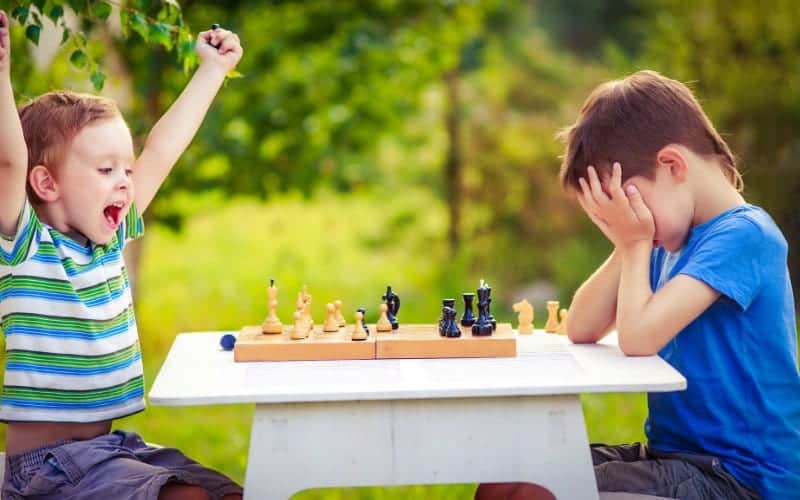
➡️ A child can’t lose well if they never get to win.
➡️ Only a child who thinks they’re a winner is able to lose well.
BAM.
What To Do When Your Child Is A Sore Loser
The truth is, the problem stumped us.
But when we figured out what to do (with Sandy’s help) then this problem got nipped in the bud in one hour. I repeat, in one hour this problem got resolved and he’s never struggled with being a “sore loser” again.

First, Don’t Preach to the “Sore Loser”
Honestly, when a child freaks out after losing it can trigger something in us.
We don’t want to raise sore losers.
We picture our children losing gracefully and shaking their opponents (and siblings) hands and congratulating them.
We think it’s very morally upstanding to lose well so – if our children start to exhibit difficulty losing – we are kind of embarrassed.

Bye, Bye Backtalk
But we need to hang on to a few things:
- Share the lessons you want to teach, but don’t preach. Telling them not to be sad/angry/upset will not work. It will only make them feel worse. Do you think they like feeling bad? No, of course not.
- Making the scene even more strained won’t help. Let the kids feel what they feel as long as it doesn’t cross your family boundaries.
- Children who feel like they never get to win cannot feel happy for others. The key isn’t to “make” them feel happy, it’s to help them feel like a winner.
I’m not talking about a namby pamby definition of a winner. I literally mean, a child needs to feel the thrill of “winning.” Then, when they have, they’re okay with losing because it doesn’t threaten their identity.

Give Them Clear Chances To Win
So this is what you’re here for: give your child chances to win.
Many parents feel like this…
You can’t just let kids win. They need to learn to work hard if they want to win and if they don’t win, they gotta learn to lose well. Life doesn’t let you win.
Look, I get it. In fact, I agree.
And the good news is this: life will teach them this lesson. But it’ll be an easier lesson to learn if they have felt the thrill of winning and know they aren’t doomed to lose forever.
“Sore Loser” is not a role they must always fill.

50+ Connection Questions
Pull out these fun connecting questions to share some laughs with your precious ones!
Use them at:
meal times, car rides, as a “calm down” trick, for dinner time conversation, or any time the day is getting chaotic or you need a reset to connect.

How to give chances to win:
- Take 1:1 time with your child to play a game of their choice and ask them, “Do you want me to let you win?” If they do, let them. Now they are free to play without worrying about the outcome. Kids who are worried about losing don’t have fun because they’re so stressed about losing then they quickly start to hate playing at all because they associate it with fretting then losing.
- Let them make up their own game with their rules and go with their lead.

- If you’re playing a game like baseball or soccer, force a temporary suspension of disbelief and forget about the real rules. They won’t carry this into an actual game, but give them freedom here.
- I’m not saying you should let one child falsely beat the entire family at Monopoly and have everyone pretend they won. Be upfront about letting them win, don’t trick them. Individually, give them a direct chance at winning. Be clear that’s the aim.
- Start special play times with your child. They will likely act out this desire to win during that time. (see below for more on this)
Kids will not need this forever and ever to be gracious losers. In fact, it took us one hour.

Healthy Minds, Happy Homes
Here’s Our Special Play Time Story Involving the “Sore Loser” Theme
I decided to institute Special Play Time with this particular son.
Special play time is a 30 minute block you set aside once per week (for a limited period of time) with specific toys to help your child play out what’s bugging them.
The first day I started Special Play Time, I laid out all the particular toys and gave control to my son. I let him choose what we’d play with.
An interesting thing happened…
He chose the handcuffs and the key. He was in charge of making up the game and deciding what we’d do. We spent an entire 30 minutes with him telling me what to do.
He’d lock me up, tell me I lost and put me in jail.
Then he’d uncuff me, tell me where to run, how fast to run, and when to let him get me. Then he’d lock me up again and tell me I lost.
And we repeated this for 30 minutes.
After this session his behavior improved. His mood improved. His general outlook improved. His reactions to losing and not getting what he wanted started shifting.
After only one session!
The next week I set all the specific toys out again for Special Play Time and guess what he chose? A simple game of winner and loser.
Horseshoes and stakes.
We went outside with these. He was so upbeat and ready to play. I was fascinated the entire time because he created random rules that changed the whole game based on one thing: him being able to win.
Then, when it looked like I might win… he’d change the rules!
No matter what happened, he shifted the rules so he’d be the winner and I’d be the loser. I would say, “Oh, man! You got me again!” and we’d keep going. He got his fill of winning. Felt the thrill of victory and the power to get what he wanted.
And that boy has not acted like a “sore loser” since. And that was months ago.
It’s A Small Thing That Really Makes A Big Difference
Every child won’t have this need. Some kids are naturally optimistic, self-confident, or just aren’t bothered by losing.
But some kids need this.
Don’t be afraid you’ll set some type of entitled pattern by helping your child feel like a winner. Don’t minimize them by repeating over and over that they can win if they’d try harder or get luck on their side.
Instead, think about it like sharing. You never want to share if you never get a turn.
After that combined hour of being the winner, my son was transformed from a sore loser into a contented player. If he wins, great. If he loses, fine.
50+ Connection Questions
Pull out these fun connecting questions to share some laughs with your precious ones!
Use them at:
meal times, car rides, as a “calm down” trick, for dinner time conversation, or any time the day is getting chaotic or you need a reset to connect.
He can even let his siblings win without whining and tears.
Because he felt doomed to lose, each loss was a catastrophe.
After he’s won and won until it’s out of his system, a loss is just a loss.
These conversations start as early as kids can play games. Talking to our kids about winning and losing graciously sets the foundation for parents to be able to model these behaviors and expect their kids to do so as well.
Preemptive conversations can be so helpful here! Before your child engages in a game or activity with others, have a brief conversation about good sportsmanship. Explain that people might react differently to winning or losing, but it’s important to stay positive and respectful regardless. During or after the game, pay attention to your child’s reactions to any unsportsmanlike behavior. Use it as an opportunity to have a discussion about how they felt and how they responded. Help your child see things from the perspective of the other child. Ask questions like, “Why do you think they reacted that way?” or “How do you think they feel?”
Praise effort, not just results. Instead of solely praising achievements, acknowledge and celebrate the effort your child puts into their activities. Focus on their hard work, determination, and improvement. Encourage your child to set goals that are attainable and focused on personal growth rather than just winning. This helps shift the focus from external validation to self-improvement.
::