“Yes, mommy.” This one phrase helps gain cooperation from children without coaxing and helps open the lines of communication.
When you imagine a child saying the phrase, “Yes, mommy” what do you picture?
If you’re like me, the first few times you read it you imagine a little robot-like child with a defeated expression saying, “yes, mommy” in a tone of voice that sounds like that “we don’t need no education” Pink Floyd song.
But really, the phrase “yes, mommy” is nothing like that. Nor do my kids sound like that when they use it. At all.
In fact, after I started enforcing the “yes, mommy” phrase I was really surprised at their responses and the ways in which it helped us.

When to use “yes, mommy“
- After you’ve issued an instruction such as, “Please come to the table to eat.”
- When you’re telling your child something not to do, for example, “Do not touch the oven, it’s hot. Do you understand?“
- When you are trying to get your child’s attention, and want to know they are listening.
How “yes, mommy” is changing our interactions
I recently re-read this book which is all about shepherding and training your child’s heart, not just seeking obedience.
You want to teach your children why we do things, not just raise some tiny human who does everything you want. Because what happens when you aren’t there, right?
So anyway, this phrase “yes, mommy” was a central point in the book for some of the following reasons.
1. It is preemptive.
A great time to ask your children to use the phrase “yes, mommy” is after you’ve given them an instruction.
A normal scenario, but not ideal, would be you issuing an instruction like, “Please clean your room,” to which they do not reply because they weren’t looking or listening.
A better scenario is this. Have your children look at you as you say, “Please clean your room,” and then have them respond, “Yes, mommy” if they’ve understood and agree.
This phrase is preemptive because it gains their cooperation from the beginning. It prevents battles because you’ve asked them 1200 times and they’ve ignored you every time.
It prevents you repeating yourself many times because they respond immediately that they’ve understood.

Bye, Bye Backtalk
2. It opens the lines of communication.
Often I need to have my children do something I know they won’t like. One of mine tends towards whining (although these two things have greatly reduced this), and the “yes, mommy” phrase has really worked well with him because it is a form of buy in.
Before using the “yes, mommy” phrase, my son would melt down or start whining immediately if he heard instructions he didn’t like.
Now, he sees this as an opportunity to enter into conversation, which is much preferable to whining.
I might say, “We are going to eat and then fold the towels before we play outside. Say ‘yes, mommy‘ please.”
Now, if that doesn’t please him, he will visibly try to get himself under control so he can speak with me instead of just flipping out. Because I’ve asked him for a response, he might say, “But mom, I don’t want to fold the towels, it’s hard!“
Then we can have a discussion from there instead of him simply ignoring me or having a meltdown.
I’ve found this phrase really encourages the kids to explain their reservations or ask questions instead of just ignoring me and then having to repeat myself.
3. Once they agree, they’re more likely to follow through.
It’s true of both children and adults, once someone agrees to do something they are more likely to do it.
Sure, fine, it’s possible to back out on your word. But once my kids have said, “yes, mommy” they’re far more likely to do what they’ve said.
Why?
Because they have listened to my words and come into agreement. Sounds silly, but trust me it works.
This is especially helpful for instructions issued that are going to happen in a few minutes. I like to prepare my kids for what’s coming next, and if your kids have heard the plan a few times and responded, “yes, mommy” a few times as well, there will rarely be battles.
If you don’t believe me, try it.
Read: Quiet time (Rest time) for Toddlers: All You Need to Know

Discipline with Dignity

4. They agree happily instead of fighting unhappily
When I first decided to really buckle down and use this phrase I was sure it was completely ridiculous and would not work.
I am so glad I was wrong. 9 times out of 10 my kids will respond to instructions or prohibitions with a happy and cheerful, “yes, mommy!“
When I’m speaking to them in a kind and calm voice, they respond likewise. Kids know you’re the mom. They expect you to tell them what to do.
How could it be any other way?
Asking them to say, “yes, mommy” is essentially asking them to agree that they have understood or will do what you’ve asked.
When given the choice, children will usually respond favorably because they do want to please you. So it makes sense.

50+ Connection Questions
Pull out these fun connecting questions to share some laughs with your precious ones!
Use them at:
meal times, car rides, as a “calm down” trick, for dinner time conversation, or any time the day is getting chaotic or you need a reset to connect.
Want some Helpful Phrases Printables?
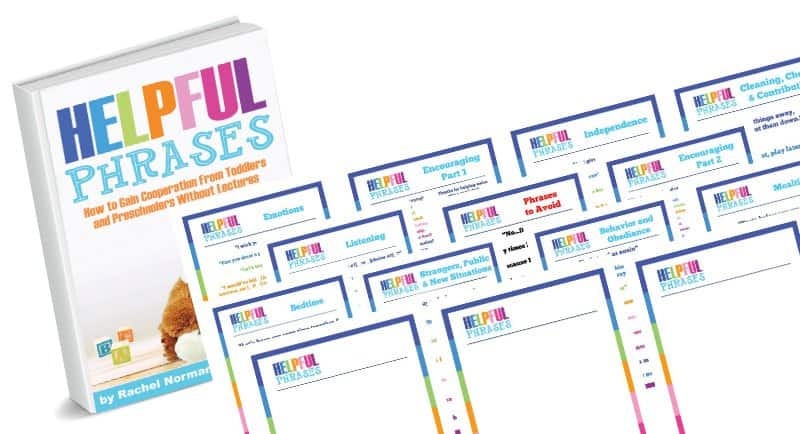
Because helpful phrases make life with kids *so much easier* and they work – even science says so! – we have created a book chock full of printables for various situations. Whether it’s mealtime, tantrums, how to listen, bedtime, etc. we’ve got a book full of phrases to help you be the parent you want to be. Check it out here in both digital and paperback.