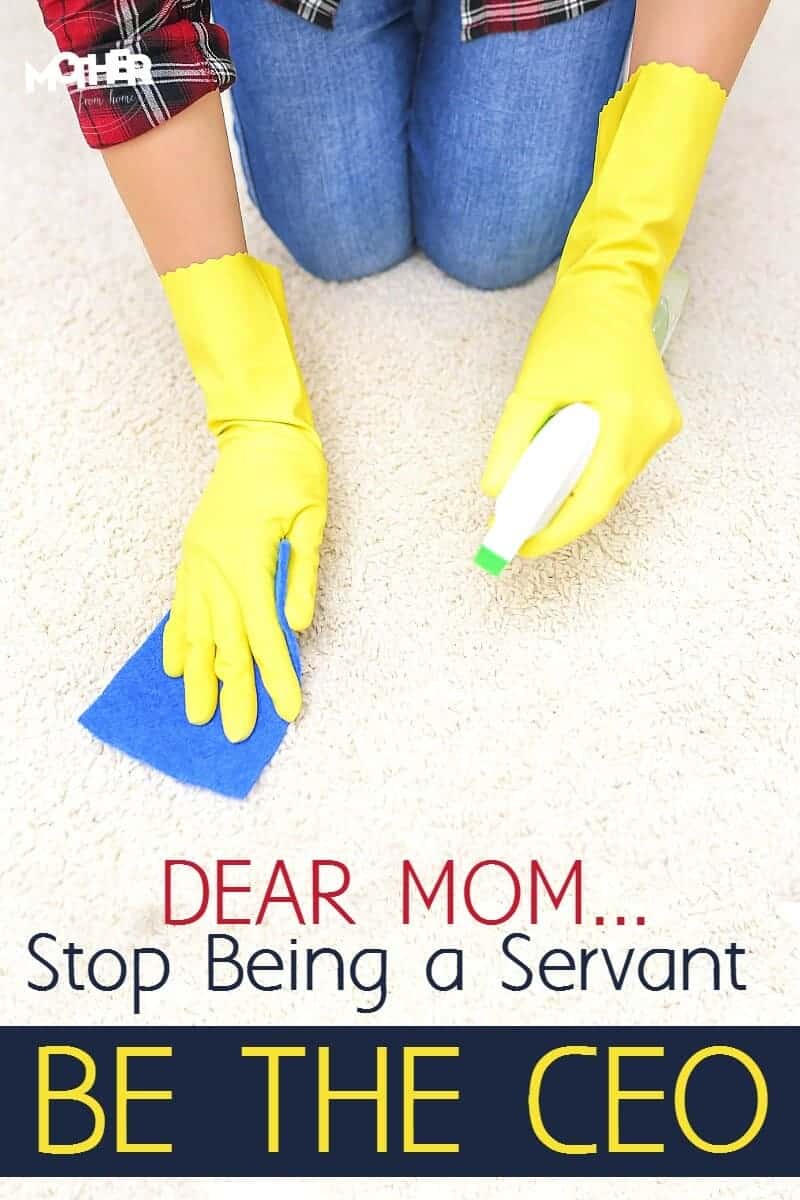
Moms wear many hats and have many responsibilities, and yet… they shouldn’t be the home servant. Everyone benefits with a CEO mom.
Every single thing.
All cleaning, cooking, organizing, tidying, shopping and planning.
That is what I thought I had to do to “have it all together.” Surely, I imagined, a mother has to be a master of time management and prioritizing and find a way to do it all to be considered on top of things.
If she can do everything that has to be done and have time to socialize, well, then she’s the Mythical Supermom.
This humongous lie kept rattling around in my brain until one day – while reading business advice – I realized my gross error.
The error that made me feel guilty.
An error that made me feel frazzled.
The error that was holding everybody back.
And the error was this… my mindset.
I was maintaining the mindset that I was the one who had to do everything. It was my job to get it all done and organize it all and run with everything.
But really, I was misinterpreting what my own role had to be. I constantly felt pulled in every direction unable to get it all done.
That’s because I can’t. And that’s okay.
Read: How to Raise Cleaning Machines: An Epic Household Chore List
How you can be a CEO and not a Servant
There’s nothing wrong with serving and loving your family. Big Fat Obviously.
Yet, there is a much different feel to a home with a mother who sees herself as the CEO over household matters, and not just the one on the floor with a toothbrush.
(Note: This is not about being CEO over your husband so don’t send me hate mail. I’m talking about being the leader of whatever duties and roles you already take charge of in your home.)
Read: The Quick Guide To Getting Started With Chores

You don’t have to do it yourself
Imagine if the CEO of Delta Airlines also distributed the mail, swept the floors, hired every single pilot, and ordered the office supplies.
It’s insanity.
This is because while it’s the CEO’s job to make sure everything gets done in a timely and efficient way, they don’t do everything themselves.
As a mother, you are in charge of much of the child rearing and homemaking. This, however, does not mean you have to do everything alone.
Here are some ways you can get help for yourself and your home without you using your own hands and feet every time.

If Mama Ain’t Happy: Boundaries For Moms
Examples of automatic ways to lessen your load
- Food Subscription Services | There are quite a few food delivery services that send you fresh ingredients straight to your home. The food is fresh, easy to cook, and I totally see using this in busy seasons or post-pregnancy, for example.
- Amazon Prime | Free 2-day shipping. There are many times it’s quicker to buy with one click on Amazon Prime than to plan for a big trip to the store.
- Amazon Pantry | You can create an account with Amazon and have pantry items (as well as diapers, etc.) sent to your home at regular intervals. This means you aren’t frantically going to the store at the last minute for diapers. I’ve put this off, but need to do it.
- Cleaners | There’s no shame in having someone come help you clean. You’ll still be doing daily tidying, organizing, and cleaning maintenance, but there’s no written code that says you must clean every part of your home or else you can’t take pride in it.
- Mother’s Helpers, Nannies, and Babysitters | Depending on whether you work or not, you’ve already gotten past this. But even a stay at home mom may need help for a season. To allow her to work from home, spend time with individual children, get certain projects done that have been on the back burner. Or just to have a break.
You learn to delegate
As people progress up the promotion ladder at work they learn one thing, the responsibilities may increase, but the duties change.
CEO moms would do well to take on the same mentality.
You’ll no longer do some of the day to day things, though the buck still stops with you. Moms must learn to delegate chores, tasks, and projects to their kids.
Kids can do things. Yes, yes, they can.
“Kids can do things.”

It hurts both yourself and your children if you don’t require them to carry their own weight around the house.
These things can be as simple as tidying their room, cleaning up toys, putting away dishes, and helping with the cooking.
Essentially, you’re teaching your kids how to do the many tasks you do and, when they’re ready, handing those tasks over to them.
This may seem cruel, but really it’s kind.
Read: An Epic Household Chore List
CEO moms have oversight and use it
If we give our children chores or tasks and don’t check up on them… there’s a very high chance they won’t get done.
This is follow through on our part.
The Large Family Logistics book (which I highly recommend with a few caveats, here’s my video review) says that we must “inspect what we expect.”

It’s not enough to tell our kids to do something if we won’t actually require them to carry it out. This takes consistency, effort, and clear boundaries on our part.
It means that we’re there to help them improve their skills, finish the job, and clean up after themselves.
And, when we don’t, that there’s a clear and appropriate consequence.
“Inspect what you expect.” Kim Brenneman
If you’re consistently late, lazy, and lackadaisical in the workplace you’ll get the boot.
One of our roles as parents is to make sure we’re raising kids who work hard and work well.
Read: Chores Toddlers, Preschoolers & Early Elementary Kids Can Do Well

No Nag Chore Routines
You develop a long term strategy
The CEO is not so busy with the day to day busy work they don’t have time to strategize over the future direction of the company.
In fact, it is their job to strategize about the direction of the company.
Mothers are so busy changing diapers, chasing toddlers, cuddling kids, making snacks, potty training, and directing our kids that we often lose sight of our long-term goals.
We are not above these tasks – no way, in fact it’s a pleasure to serve our families!
However, without good working systems in our homes we frantically run putting out one fire then another without taking the time to think big.
Read: Family Culture: A Guide To Building Strong Families

50+ Life Skills (By Age!)
Check off critical household, social, and hygiene skills for your child so they’re prepared (not petrified) of growing up!
You take days off, vacation, and clock out early when you want to
I’ll never forget working in a law office in Fort Lauderdale, Florida directly after college.
Every Friday afternoon my boss would roll out of the office at 3:00 pm to take his wife, his kids, and his boat, to the Bahamas.
You know… a typical weekend.
He’d worked hard all week, lined his ducks up, delegated tasks, and trained us to do our own jobs. It allowed him freedom in his own work.
A mother doesn’t have to be a slave to run her home. She can set up good systems, delegate projects and tasks, do the things that need to get done, and then relax when she’s able.
That’s okay.
In fact, if you don’t know how to relax you’ll never be a good Home CEO because you’ll be in perpetual Survival Mode.

Self-Care That Sticks

The Culture (Home Atmosphere) trickles down from you
As in any organization, it’s management that sets the tone. It can be easy for moms to spend all day long reacting. Truthfully, I am so guilty of this when pregnant, stressed, or worn out.
I react to a tantrum or react to some naughty action or unkind word.
I react to a spill or a mess and those become anger triggers for me.
Instead, it’s the job of the big boss to create the desired atmosphere and model it. Kindness, peaceful, fun, excitement, and playfulness.
These (among a slew of others) are great things for a mother to emulate in her days with small children. Our kids look to us to set the tone, let’s not disappointment.
We need to learn to think like CEOs….
It’s about rising above the daily chaos and thinking long term.
Not because we’re too good for any particular job, but because we should be too wise to run ourselves into the ground.
Sources:
- Involving kids in household tasks has a positive impact later in life
- Chores are associated with self-competence, self-efficacy, and prosocial behavior
- Longitudinal Harvard study shows chores are bigger predictor of good mental health as an adult (moreso than social class, family problems, and other factors)