Want a schedule that will work well with your toddler? Here are the key elements to any successful toddler schedule or routine.
Those first days with baby are so magical…
Baby eats. Baby sleeps. Baby lays there looking all cute and squishy.
And then… they grow into toddlers.
Toddlers who are all over the place. They like to pack things then unpack them. They want to walk and fall and walk and fall and toddle around the house creating a trail of destruction behind them.
Toddlers walk, talk, and are Big Balls of Energy. They are amazingly cute and so fun to cuddle and, man oh man, they are a handful.
Toddlers are a handful!
No longer can you sit your little baby on a blanket while you go about your business. Now… now you got a little mobile human on your hands and the days aren’t quite as predictable.
The days start to seem longer and harder to fill. You feel a bit at the mercy of your toddler’s behavior and emotions.
And, if we aren’t careful, we begin to let our little ones start to determine the course of the day. Sometimes this is completely fine. Other times this results in overtired and fussy toddlers who need a little help.
Good thing we’re the moms!

Teach your toddler to follow their routine with printable routine cards.
Sample Toddler Schedules
Here are a few sample toddler schedules, depending on your child’s age, and then below we’ll get into all the elements that go into a good routine, and how you can make it work for you.
After you read these sample schedules, keep reading for tips on toddler daytime routines.
Sample Early Toddler Schedule
7:00 am – Wake up for the day, eat, play
9:00 am – Nap
11:00 pm – Wake up, play, small snack
12:00 pm – Eat with family
1:00 pm – Nap (naps just after lunch help keep the little one asleep longer)
3:00 to 3:30 pm – Wake up, snack, play with family
5:30 pm – Dinner with family
6:30 pm – Bath, wind down routine, settled for bed
7:00 pm – Feed then down to bed
Now here’s a sample toddler schedule for an 18 month old. This will be similar to the 1 year old sleep schedule I have here.
Sample Mid-Aged Toddler Schedule
8:00 am – Wake up, eat breakfast
9:00 am – Independent playtime
10:00 am – Snack, errands, outside play, education activities, crafts, exercise, etc.
11:30 am – Reading time with mom
12:00 pm – Lunch
1:00 pm – Lunch
3 to 3:30 pm – Wake up, snack, play until dinner
5:30 pm – Dinner with family
7:00 pm – Wind down routine, reading books with family, bath, getting ready for bed
8:00 pm – Bedtime
So that’ll get us to the 2 year mark or so, here’s a schedule for older toddlers.
Sample Older Toddler Schedule (2 to 3 years)
6:30 am – Wake up, read books, play quietly
7:00 am – Breakfast, clean up table area, morning chores
8:00 am – Play independently
8:45 am – Run errands, play outside, do homeschool preschool or learning activity, free play
9:30 am – Snack
12:00 pm – Lunch with family
1:00 pm – Down for nap, if child is going through a sleep regression, still put your toddler down for a rest, they are likely to fall asleep
3:00 pm – Wake up, have snack, play quietly, cuddle time with mom
6:00 pm – Dinner with family
6:45 pm – Wind down, bedtime routine, bath
7:30 pm – Bedtime
Independent play (playing on their own) for toddlers
For little ones, you may have them play in a pack ‘n play or their crib. You’ll give a few toys and then walk away, allowing them to explore. This Quiet Time can be valuable.
Naturally, you’ll remain where you can see them and hear them, but don’t stand in view. If your toddler sees you standing there they won’t calm down long enough to engage in play.
The goal is for them to begin to play on their own without having to be entertained. There’s a big difference between playing and being entertained.
Related Reads:
Chores or “Help” Time
Even little toddlers can learn to clan up after themselves and help mommy and daddy. When creating your toddler schedule, think about the little things you do throughout the day without even thinking.
The first “chore” I taught my 2 year old was how to straighten the pillows in his crib before he gets out in the morning. He simply picks up the pillow and puts it at the end of the crib. Then he adds a toy or two and, voila!
He’s “made his bed.”

No Nag Chore Routines
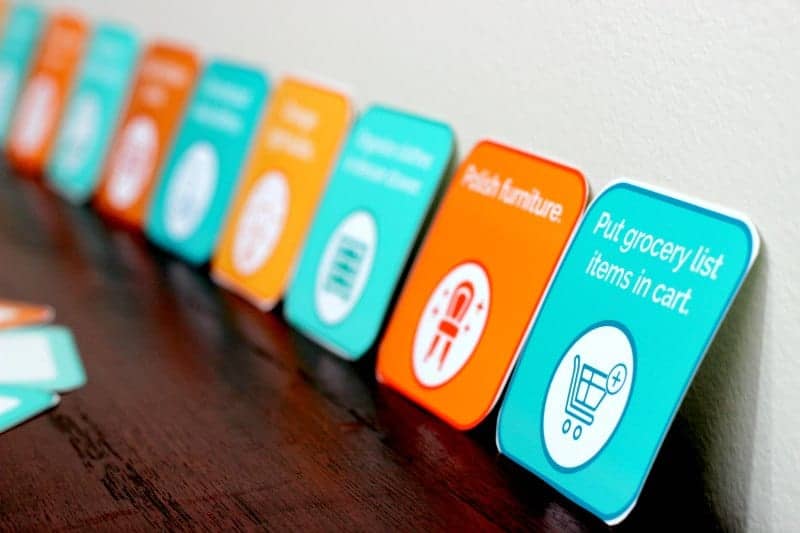
This age is magical. Children love to be with you and help you do many things. They can learn to put their toys back up. In fact, after independent play you can ask them to put toys back into a basket or toy box.
You’d be surprised how easy it is for children to pick up on this habit. In fact, when they are still little they think it’s fun.
Age Appropriate Chores for Toddlers
- Straighten bed or crib
- Put clothes in laundry hamper
- Sweep (or help use dustpan)
- Bring their dishes to the dishwasher or sink
- Fold small towels
- Wipe down table
- Wipe cabinets
- Clean toilet with brush
Read: The Ultimate Household Chore List
Time for Books – Important In A Toddler Schedule
My first two children would sit through an endless stack of books from a very young age. My third and fourth would not.
Please, whatever you do, do not stop reading because you have active little ones who struggle to sit still. Read anyway. Require them to sit still for a bit and then, if they want to play on the ground quietly while you read, let them.
Reading increases vocabulary, promotes literacy, and makes the child’s world richer. It helps the learn to listen, comprehend, and is a special time between child and mom where the rest of the world stands still.
Read: How To Read To Kids Who Won’t Sit Still
Reading is a great way to help busy toddlers wind down as well so reading before nap and bed is a good way to fit it in while helping your child get into a calm state.
If they aren’t enthusiastic readers (or listeners) but are very interested in a particular thing, like dinosaurs, then read as many books as you can on this subject.
Children love this interaction with mom so try and fit this in throughout the day.
Read: Curious Behaviors That Come With Toddler Teething
A Regular Bed Time with Toddler Wind Down Routines
I have heard people say numerous times, “He won’t go to sleep until 9 or later. He just refuses.”
To this I want to humbly encourage you, strong mama, that you are the mother.
You choose the bedtime.
Yes, you can only lead a horse to water and not make him drink… but not leading your toddler to bed will mean he definitely doesn’t sleep.
And when it’s at a proper time that allows for adequate sleep, you AND your little fiery toddler will thank you. And know that, if you don’t have a consistent, you’ll have a lot more bedtime battles.
Read: The Smart Toddler Bedtime Routine

Sleep Little Lamb (Ages 0-5)
How to choose a bedtime for your 2 or 3 year old
Decide a bedtime based on what works for your family. Most kids up until the age of 6 or 7 go to bed by 7:30 or 8:00 pm. This allows for 10 to 12 hours of nighttime sleep.
Younger toddlers can often seem to get more energetic as the evening progresses, but rest assured, this is a sign of over tiredness, not a sign they should stay up later. In fact, if your toddler wakes up at 6:30 p.m., you might be surprised to know they might fall asleep easily at 6:30 p.m.
Regardless of what time you choose, implement a wind down routine to go along with it.
Read: 5 Instant Ways To Get Hyper Kids To Settle Down

This might be a bath, a bedtime snack, reading, singing, or cuddle time with mom or dad. Try and find some types of activities that are calm, quiet, and help your toddler’s baby and mind to settle down and prepare to sleep.
This is also the age where fear of the dark comes in, so use this 10 second trick so your toddler doesn’t become too scared of the dark. If your toddler is used to going to sleep at the same time each night their bodies will get used to it.
Pretty soon, right around bedtime, they’ll start yawning and rubbing their eyes.
This is the magic of a consistent bedtime.
Read: The Nap Trap- How to Deal with It and Not Resist It
Time is so precious…
The toddlers years can seem so difficult while we’re in them. We are constantly hyper-vigilant and feel emotionally exhausted by the end of the day. But it does get better.
They grow up and get bigger.
They become more independent and less needy.
And they stop throwing as many tantrums.
So in the meantime, mama, as you are navigating the mines of toddlerhood, take heart.
“The days are long, but the years are short.”